

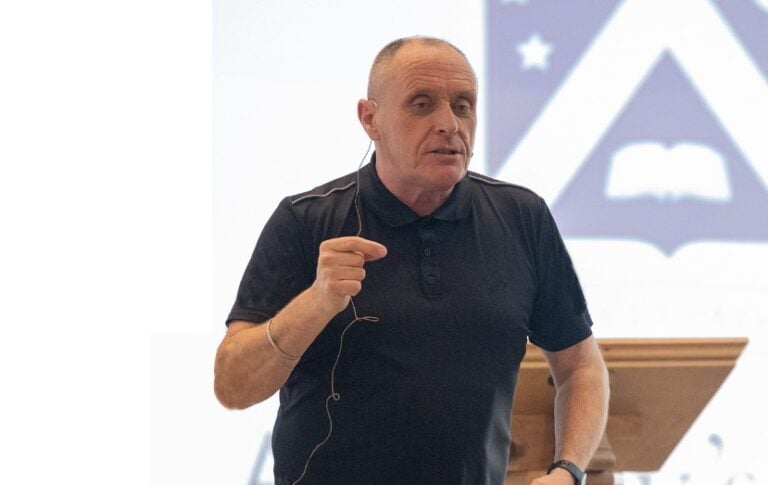
Huia Award 2026 recipient
Imagine drawing out $600 from your savings account, then proceeding to hand $60 to 10 strangers as you walk home. To John Parsons, Age Concern New Zealand’s latest Huia Award recipient, this analogy helps explain a common scam seen today where a criminal convinces people to send Prezzy Cards for payment.
“The online world and real world have more similarities than differences” says John, “and examples that reflect our everyday life help when educating all people, whether it’s children, their parents, or older people.
“If I delete something, I throw it away. If I back something up, I store it in the shed. If I’m downloading something, I’m getting something off the shelf at a shop. If I talk online and place messages in public online spaces, I’m standing on a street corner telling complete strangers my personal details.”
It is John’s ability to make a complex and sometimes frightening subject more accessible and understood by older people in Southland that is being nationally recognised this October by Age Concern New Zealand.
John is a Cyber Safety and Risk Assessment Consultant at Citizen21 who has been collaborating with Age Concern Southland for over 10 years and has educated hundreds of older residents, so they are more prepared and able to avoid cyber-crime.
Karen Billings-Jensen, Chief Executive of Age Concern New Zealand says “It’s important that we bring all New Zealanders along as we introduce new ways of connecting online – education and support are critical. John creates environments where older people can ask questions without fear of being judged and goes above and beyond to support isolated and vulnerable older people who are often key targets for criminals.”
John’s passion, commitment, and genuine respect for older people is recognised by the judges panel who selects three recipients each year to be recognised through the Age Concern New Zealand Huia Awards. John will join other recipients at an award ceremony hosted by Hon. Casey Costello on 30 September 2026.

What makes John particularly unique is the support he provides when education alone is not enough. Funded through Invercargill East Rotary Charitable Trust, John makes himself readily available to work one-on-one with older people who have been targeted by scams, giving Age Concern Southland clients priority.
He works alongside social workers to help victims understand what has happened, secure their digital and financial lives, and regain confidence.
John describes the people he supports as victims of crime, not cyber-crime. The emotions they feel are real and the impacts are no different whether they are from a person standing in front of you or a person online. He believes there is no such thing as a digital citizen, but citizens who use digital technologies, and while technologies create efficiencies, it can also make those people who are already isolated in society, even more vulnerable, as the need to interact with a real person reduces.
Isolation and vulnerability are what criminals want – it gives them access to a person and the shame or fear of talking with others means the criminal can control the conversation and actions more easily.
John shares a story of a widow who took the opportunity to travel and was befriended by a local person in a market. They stayed connected online when she returned to New Zealand, and soon the stories of unwell children and poverty began, along with the pressure to send money. Often criminals are making contact in the middle of the night when people are tired and at their most vulnerable. John tells us that this is a common scam and criminals look out for people in international markets to connect with, often building trust through giving a gift first.
He also shared a story of visiting a person because the family suspected a romance scam. Sitting on the shelf was a photo of the person taken 12 months before. John remembers her haircut was striking in the picture, and it was a completely different person sitting in front of him. The impact of the crime was evident, and the ‘act of kindness’ that this person thought they were doing meant she wasn’t sleeping properly and it was impacting her health and wellbeing. After explaining what the criminal was doing and examples of behaviours that ‘rung true’ for the victim, she agreed to stop contact with the ‘online friend’ for two weeks and review how it went.
John helped close her social media and phone accounts, setting up new ways to stay connected with real friends and family. Staying connected is so important, as it means people are more likely to talk with others about situations and avoid scams. Having the space to not be influenced by the scammer, this person was able to understand the full impact on her life. Next time John visited, he was over the moon to see her snazzy haircut had returned and she was smiling.
“When I meet someone new, I try to look at the world through their eyes. What led to a criminal being able to manipulate them, what was missing? And, how has it affected their food and housing security.” In many situations, one of John’s first recommendations is to connect an older person with their GP for ongoing support.
He recognises that crime often impacts a wider group of people, and support is needed for family too. His work alongside social workers has developed his approach that respects older people. In the very early days Annette Milligan, former director of Independent Nursing Practice in Nelson and Police Officer John Odanavon (QSM) where major supporters and mentors. More recently, John has worked with Age Concern Southland and believes Emma (Casey) is “everything you need in a social worker – compassion, caring, and how she works with all members of a family.”
John also attributes his approach to two things – a supportive family and being dyslexic. Unfortunately, John and his sisters lost their parents tragically when he was only 13 years old. He still remembers his ‘fierce’ mother who spent time popping in to visit people on the Birmingham housing estate, where he grew up. “My mum had an incredible giving nature and was a wonderful caring person.” John’s parents were good people, and his early upbringing has shaped his respect and caring approach with others.
Dyslexia has enabled John to look at situations differently, developing solutions that others may not think of. He sees it as a gift, and it certainly hasn’t stopped John learning and developing a career. He studied information technology with a focus on radio frequency identification and security. He has a keen interest in the study of non-verbal body language and the effects of dopamine on the brain. This helps him in his education and when working in situations where exploitation and harm has been committed against children. This later led to John developing workshops to support cyber safety education in schools and publishing a book titled Keeping Your Children Safe Online.
Today, with funding through Rotary, he continues to work alongside schools, police, faith groups, business, and community organisations like Age Concern Southland. He thanks Karen Purdue, Paul Tuckey, John Prendergast and the current President Candace Bangura at Invercargill East Rotary Charitable Trust for overseeing this important work to educate New Zealanders on online safety.
Nominations for the Age Concern New Zealand Huia Awards are received by Age Concern across Aotearoa New Zealand, and it is an opportunity to recognise people who are making a significant difference to the lives of older New Zealanders. Many Age Concerns offer digital literacy programmes as part of their health promotion work. John says that “being recognised by people he has immense respect for is humbling to say the least.”
When John first heard about being a Huia Award recipient, he wondered ‘how did I get here?’ His thoughts went to how proud his parents would be, and shortly after his phone lit up with messages from his wife and children – he was drawn back to being a ‘citizen using digital technology’ – his thought was ‘it’s worked out for me, you know.’