

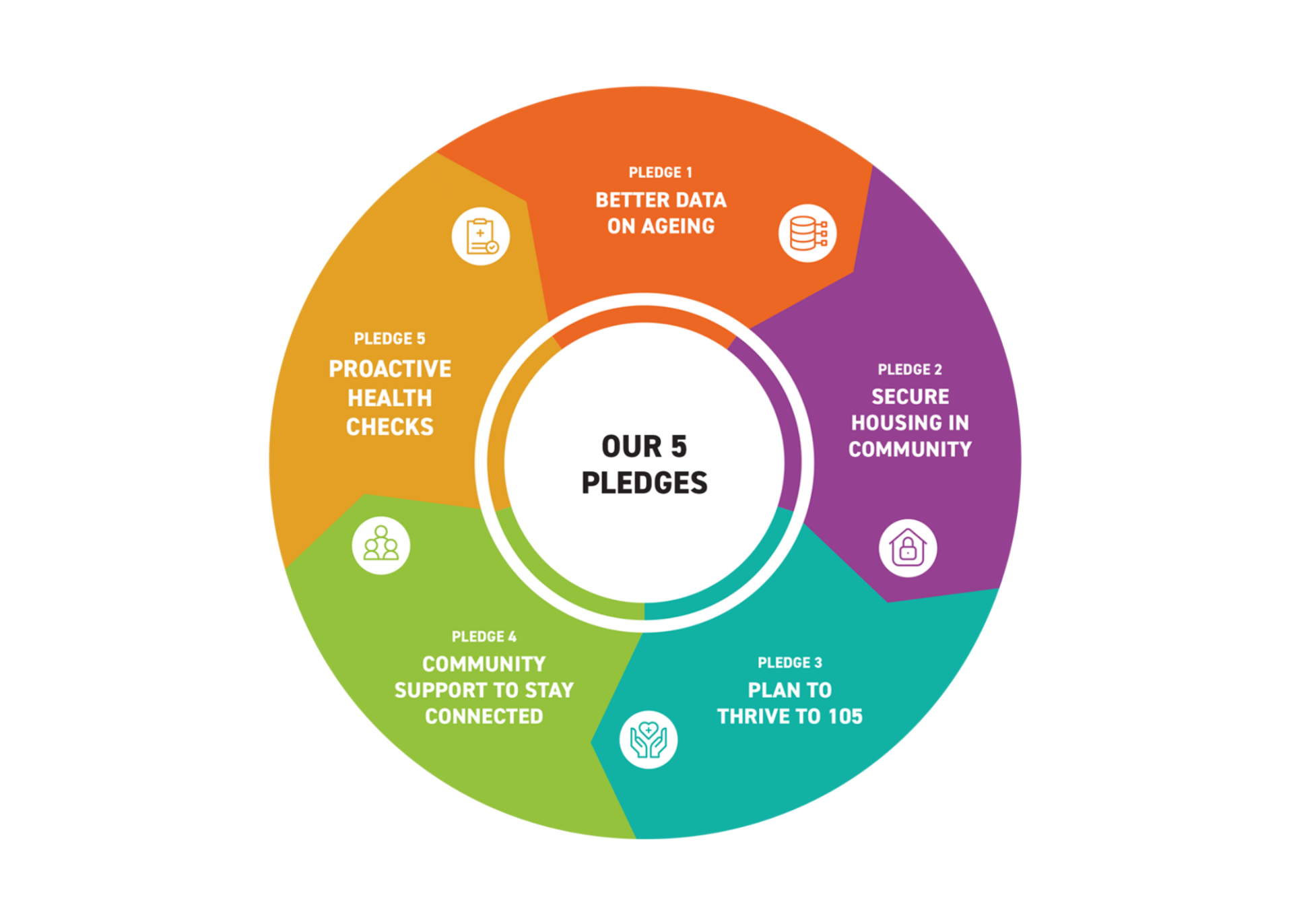
In 2025, the Aotearoa New Zealand National Forum for the Decade of Healthy Ageing launched five pledges, calling for urgent action to help New Zealanders age well and thrive. Age Concern New Zealand is one of the founding leaders and stands beside the other members to make positive change.
The pledges are grounded in evidence and focus on some of the most significant challenges facing older people today. Read about each of the pledges:
Change the way we report on older generations by disaggregating data and highlighting strengths and contributions not just challenges or needs.
Why?
New Zealanders live full and productive lives beyond the age of 65, and we know that employment rates are increasing for 65-69, 70-74 and 75+ year olds. However in definitions of the ‘working age population’, it is often assumed that those over 65 are
retired. In data and reporting, older generations are treated as a homogeneous group of ‘over-65s’ that does not accurately reflect the diversity of life stages.
When people aged 65 and over are treated as a single group, we ignore critical differences in health, income, culture, capability, needs and aspirations.
This not only distorts public understanding, it drives outdated assumptions and poor decision-making across policy, service delivery, funding, design and innovation.
Therefore – to better recognise the contribution and improve decision-making – we need to change the way we characterise age groups beyond the ambiguous ‘over-65’ category.
Action:
We will work with Stats NZ and other government agencies, researchers, media and private sector organisations to change the way we report on data for over-65s by disaggregating the data into separate age and other policy-relevant segments e.g. renters and homeowners, employed, business owners and volunteers.
Progress tangible improvements to address housing insecurity for older people starting with practical changes to make homes suitable for ageing in place.
Why?
Housing is central to healthy ageing, financial well-being and independence. When older generations can age in community, they are more able to participate in the things they love such as work, volunteering and supporting their families and wider community.
Within Iwi and hapu, older Māori are critical to the intergenerational transfer of knowledge and culture. While New Zealanders want to age well within their communities, much of our housing stock is not suitable or stable to support this. The quality and
appropriateness of housing is an urgent issue, and only 5% of rental housing is physically accessible for older people.
Furthermore, we know that 40% of Kiwis aged 65+ are reliant on superannuation and one in fi ve are still paying a mortgage. By 2048, the number of over-65s renting is expected to double.
Action:
We will work with government, Iwi and community providers to identify and implement practical improvements that can make housing safer and more secure for older generations. This includes expanding uptake of existing supports for home
modifications, trialling local housing navigators for older renters, and prioritising minor changes that make a major difference – like heating, access and bathroom safety.
We will champion these efforts as part of a national effort to move from reviewing the problem to acting on what we already know works
Empower people to plan for a full, active and independent life. This means linking financial, housing, health, wellbeing and learning/career planning into a cohesive longevity pathway through careful planning.
Why?
New Zealanders born in the 2020s are expected to live to 88 (males) and 91 (females). But a ‘healthy life’ expectancy is considerably less: 70.7 years for males and 72.3 years for females. While New Zealanders are living longer, these additional years are not always years spent thriving.
In 2023, the median weekly income for those aged 65 and over was $475, compared to $921 for all age groups, reflecting a significant income disparity.
Approximately 40% of individuals aged 65+ depend solely on New Zealand superannuation payment for their income, with an additional 20% having only a small amount more. Disparities are far worse for Māori and Pacific people, and women also generally have less net wealth at retirement.
Empowering people to make comprehensive life plans that connect both social and economic considerations will therefore support greater agency and preparedness for all life stages. A new kind of ‘toolkit’ is called for, designed to help every New
Zealander build a plan that provides a clear, integrated life-stage approach. Spanning fi nance, housing, health and career/purpose, this personalised plan will help support choice, security and independence beyond 30+ years as a senior.
Action:
We will develop and implement a toolkit that supports interconnected lifetime planning. We will work with NGOs, Iwi and government agencies to utilise existing resources, knowledge, Te Ao Māori and shared experiences so that a plan to thrive will be a new social norm for a longevity era.
We pledge to empower people to plan for full, active and independent lives. This means linking financial, housing,
health, wellbeing and career planning into a cohesive longevity pathway through careful planning.
Expand community-driven wrap around services that support seniors to age well in place in age-friendly communities.
Why?
Social isolation has been associated with an approximately 57% increased risk of Emergency Department visits and a 68% increased risk of hospitalisation. 17% of people aged 65+ in New Zealand are socially vulnerable, and 50% of those over
80 are lonely all or most of the time. We know that loneliness is hazardous: almost a quarter of those who are lonely may be at risk of premature death. Being lonely or socially isolated is also a barrier for seniors in accessing support services.
The most effective way to support older people to stay connected within their community is through a coordinated network of existing trusted community services such as Iwi, NGOs, churches, community groups and leaders. Through improved coordination and an approach that puts whānau and the older person at the centre of services, we can better enable
access and participation.
Action:
We will apply proven models of community-led coordination and replicate this in the context of older generations. A community-led model should include Kaupapa Māori services that can offer culturally appropriate care for Māori, promote Mātauranga Māori, tikanga Māori and whānau-centred models of care.
Through local design, cultural relevance and whole of-person support, we can enable more people to age well in community.
Roll out proactive, community-based health checks that empower older New Zealanders to make informed decisions and take preventative action to support longer, healthier, more independent lives.
Why?
Many chronic conditions and age-related impairments can be prevented, delayed or managed better when risks are identified early and people are supported to take action. Conditions such as dementia can be reduced through lifestyle changes, early screening and intervention.
A shift toward prevention through early intervention will therefore support longer periods of wellbeing, independence and contribution while contributing to a reduction in both unnecessary hospitalisations and demand for long-term care, especially when embedded in trusted local settings.
75% of life expectancy gains are made after age 65 making later-life prevention a powerful opportunity for public health impact. Creating a participative primary prevention approach using trusted, community-based providers will empower older people andwhānau to maintain health and autonomy.
Action:
We will pilot community-based health checks for older New Zealanders, delivered through pharmacies, marae, hauora services and other trusted providers. These checks will be based on health planning and screening tools that go beyond disease screening to support people with tailored prevention plans according to their health needs/risk profile.
Community-led design is essential to the implementation of this pledge to ensure equity, accessibility and meaningful impact and avoid putting further pressure on the health system. Implementation will begin with funded pilots in diverse communities, and expand through partnership with PHOs, Iwi providers, aged care NGOs and health agencies.
Healthy ageing is one of the most important opportunities facing Aotearoa.
When older people can remain active, connected and independent, everyone benefits.
- Communities become stronger.
- Health systems become more sustainable.
- Families receive greater support.
- Workplaces retain valuable experience and expertise.
- Future generations inherit a society designed for longer, better lives.
Change requires action from all of us – government, organisations, communities, whānau and individuals.
Together, we can challenge ageism, strengthen social connection, advocate for age-friendly policies and ensure every person has the opportunity to live with dignity, purpose and wellbeing throughout their later years.
Download the Age-friendly Media Guide and read more about the forum or you can go to the NZ Decade for Healthy Ageing website for more information.